

Mandalorian Filming Locations Guide: Real Places vs. the Volume Studio
When The Mandalorian premiered on Disney+ on 12 November 2019, many fans assumed they were seeing far‑flung deserts and remote canyons on screen. In reality, most of those worlds sit inside a soundstage in Southern California, wrapped by a giant wall of LED screens.
The series, created by Jon Favreau and produced by Lucasfilm, leans heavily on Industrial Light & Magic’s StageCraft system. Cast and crew often just call it “the Volume.” Real outdoor locations are the exception, not the rule, and truly accessible filming spots are rarer still.
For Star Wars fans planning a trip, that mix can be confusing. Can you visit the planets of The Mandalorian at all? And if the Volume does most of the work, where does it actually live?
Here is a grounded guide to what was filmed where, what you can reasonably visit, and what only exists on LED panels.
The Volume: How The Mandalorian’s Worlds Are Really Made
StageCraft is ILM’s virtual production system. It surrounds a physical set with a huge LED wall and ceiling, then drives those screens with real‑time 3D environments.
For season 1, ILM installed the first Mandalorian Volume at Manhattan Beach Studios in Southern California. The production used a stage about 21 feet tall and 75 feet in diameter, with a semicircular 360‑degree LED wall and overhead panels. Real‑time rendering came from Epic Games’ Unreal Engine, which let the background imagery move correctly with the camera while also lighting the actors.
Principal photography for season 1 ran from early October 2018 to 27 February 2019, largely inside this Volume at Manhattan Beach Studios, with only limited exterior work around Los Angeles.
For season 2, ILM expanded the system. The updated Volume grew in physical size and resolution, and ILM introduced Helios, a custom real‑time render engine built to handle more complex scenes. Production reports describe season 2 as being filmed entirely inside studios in El Segundo and at the MBS Media Campus in Manhattan Beach, with digital environments projected on enormous LED screens. Filming for that season ran from November 2019 to March 2020, wrapping about five days before COVID‑19 lockdowns began.
Season 3 followed the same general pattern. Filming started in October 2021 and ended in late March 2022, with some additional shooting in early July 2022. The show again based itself at MBS Media Campus, with further work in Burbank and the wider Los Angeles area.
So although the planets look scattered across the galaxy, in practice most of The Mandalorian lives inside a handful of soundstages in Los Angeles County.
MBS Media Campus and the Volume: Where It Is, and Why You Can’t Just Walk In
The physical home of The Mandalorian’s Volume is the MBS Media Campus in Manhattan Beach, California.
The lot sits at 1600 Rosecrans Avenue, Manhattan Beach, CA 90266. According to facility data, the campus covers about 22 acres and includes:
- 15 sound stages totaling roughly 385,000 square feet
- About 190,000 square feet of office space
- Around 110,000 square feet of support space
- Roughly 1,352 combined vehicle and trailer parking spaces
MBS lists The Mandalorian alongside Obi‑Wan Kenobi, The Book of Boba Fett, and several major films as productions based there. It also notes that ILM operates a “state‑of‑the‑art virtual production volume” on the lot.
However, this is not a theme park.
Manhattan Beach Studios, which operates stages on the campus, describes the property as a “world-class secure lot” with a 24/7 security gate. Visitors must show ID at the gate entrance before they can enter. Security cameras monitor the site, and rules govern how even delivery drivers and drop‑offs move through the property. The studio targets professional productions, and the public website focuses on stage rentals and production services, not tours.
As of late 2025, there is no regular public studio tour for the MBS Media Campus and no advertised way for fans to see the actual Mandalorian Volume.
The one time fans could step into a Volume
Lucasfilm has occasionally brought StageCraft to fans, but only as special events. At D23 Expo in Anaheim, ILM assembled a fully functioning StageCraft Volume on the convention floor. Attendees stepped onto a tracked stage and watched environments from The Mandalorian and other Disney+ series render live around them. ILM chief creative officer Rob Bredow highlighted that demo as a rare public look at a wall boasting 18.5 million pixels, tied into a live‑tracked camera.
For now, those convention setups are the only realistic chance a regular fan has to stand inside a working Volume. They are temporary builds, not permanent attractions.
Rocky Peak Park: The One Major Battlefield You Can Actually Hike
If you want to stand on ground where a key Mandalorian scene was filmed, Rocky Peak Park in California is your best bet.
The park appears in Season 2, Chapter 14: “The Tragedy.” In that episode, Din Djarin takes Grogu to the ancient seeing stone on Tython, only to face a full‑scale assault that brings Boba Fett roaring back into the story.
Behind‑the‑scenes material and location guides agree that major action from this episode was shot on location in Simi Valley, rather than in the Volume. Atlas of Wonders and other trackers identify the site more precisely as Rocky Peak Park, a rocky open space in the Santa Susana Mountains between Chatsworth and Simi Valley. Those same sources describe this as the first time The Mandalorian filmed on location instead of entirely on soundstages and backlots.
A detailed 2025 breakdown from BobaFettFanClub walks through the exact hiking route. The writer traced the Boba Fett and stormtrooper battle to several clearings along the Rocky Peak Summit Trail, often only a few dozen feet from the main path.
Where Rocky Peak Park is, and how to get there
Rocky Peak Park is part of the Santa Monica Mountains Conservancy system. It is managed with the Mountain Recreation and Conservation Authority and the Rancho Simi Recreation and Park District. Entry is free and generally open to the public.
Key points:
- Location: Just off the CA‑118 Freeway, near the Rocky Peak Road exit between Chatsworth and Simi Valley.
- Trailhead: Commonly listed as Rocky Peak Road, Simi Valley, CA 93063, with GPS coordinates around 34.2683° N, 118.6361° W.
- Main trail: The Rocky Peak Trail runs about 5 miles one way along a fire road, rated easy to moderate. It eventually connects near Las Llajas Canyon.
- Other routes: The Chumash Trail (about 3 miles, moderate) and Hummingbird Trail (easier, shorter) tie into the Rocky Peak system.
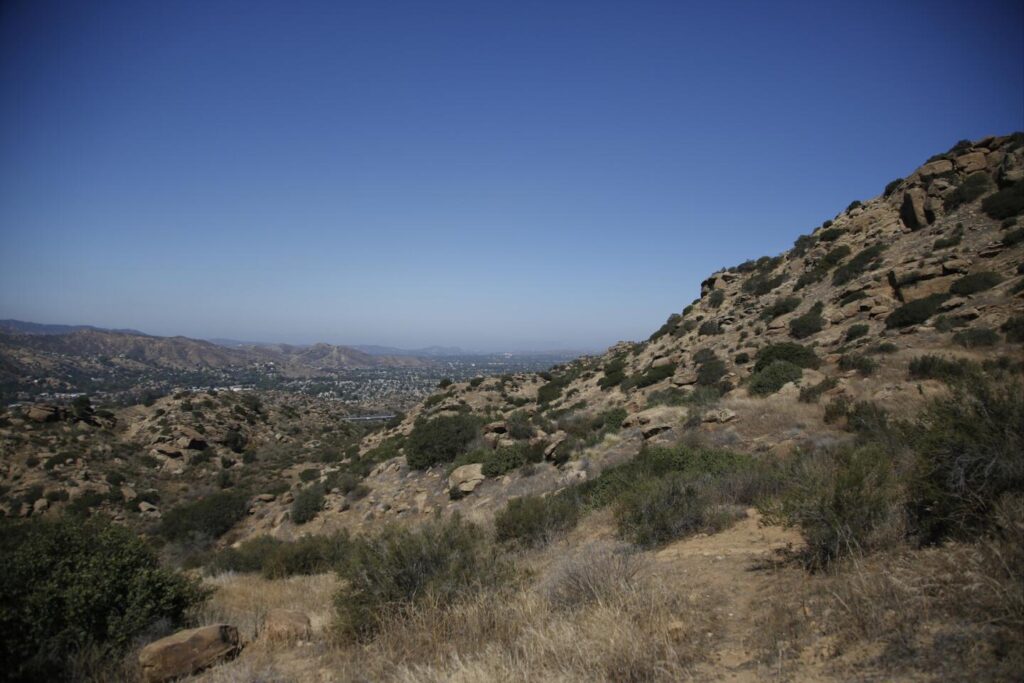
Most visitors from Los Angeles reach the park by taking Route 118 west to the Rocky Peak Road exit. A small parking area sits just north of the freeway. Because that lot only fits around six to eight cars, many hikers use overflow parking across the freeway bridge on Santa Susana Pass Road. Local guides stress not blocking the fire gate at the main trailhead.
Typical hours run from dawn to dusk. Some listing sites report posted times like 06:00 — 20:30 daily, but schedules can vary seasonally. There are no restrooms or water at the trailhead, and the terrain is rocky, so visitors should bring their own water and wear sturdy shoes. Dogs are usually allowed but must stay on a leash.
Finding the Tython battle sites
For fans, the practical question is where to look once you are on the trail.
The BobaFettFanClub hike report suggests searching hiking apps for “Rocky Peak Summit Trail” and following the main fire‑road climb. After a short uphill stretch, the path levels into a broader area. Many of the blaster fight scenes and close‑ups of armored characters were staged in a large clearing about 50 feet off the trail near this point.
The surrounding rock formations, low scrub, and sky match what appears on screen, although set dressing and digital work filled in elements like the seeing stone and some distant vistas. It is still one of the few places where you can line up camera angles and feel the episode snap into place.
El Segundo and Burbank: Where Tatooine Lives on Private Backlots
Not every “location” in The Mandalorian is a wild park. Some are outdoor sets built on private studio land.
A production breakdown for season 2 notes that the show used a 100,000‑square‑foot backlot in El Segundo, California to film many exterior scenes. That large, open space allowed crews to build sizable towns and streets that would have been harder to manage inside the Volume.
Travel and location articles report that several exterior shots of Mos Pelgo, the dusty mining town introduced in Chapter 9: “The Marshal,” were filmed on this El Segundo backlot. The cantina exterior and parts of the Tusken Raider sequences fall into that group.
However, this backlot is not a public street. It is a dedicated studio area “some distance away” from the main Manhattan Beach facility, designed specifically for productions. No tourism or studio sites advertise Mandalorian‑specific tours there as of December 2025.
Season 3 spread some of its exterior work around Burbank and the rest of Los Angeles County. Burbank is already home to major media companies and studio lots, so that choice fits the industry pattern. Public sources mention the city as a filming base but do not tie specific Mandalorian scenes to recognizable public landmarks. Without that detail, it is difficult to point fans to an exact corner or building.
In practice, that means El Segundo and Burbank matter most as context: they show how much of The Mandalorian’s “outdoor” look still comes from controlled studio environments on private property.
Real‑World Landscapes That Inspired Mandalorian Planets
Even when the crew stayed in California, the design team drew on real locations from around the world. These places did not host filming, but their shapes and textures influenced digital environments and physical sets. If you want a looser “inspired by” pilgrimage, they are still worth knowing.
Pamukkale, Turkey – the hot springs of Maldo Kreis
In Season 2, Chapter 10: “The Passenger,” the Frog Lady warms her eggs in a series of white terraced pools on an icy planet. Location analysts quickly noticed that the terraces resemble Pamukkale, a famous site in western Turkey.
Pamukkale is a UNESCO World Heritage area that combines natural travertine terraces with the ancient city of Hierapolis. Hot mineral water flows over white stone pools that cascade down a hillside. Fan location guides note that the Maldo Kreis pools mirror this look closely.
However, The Mandalorian did not film in Turkey. Sources describe the scene as a digital recreation built in the studio, with Pamukkale used as a visual reference.
For visitors, current information lists:
- Two main gates, North and South, usually opening around 6:30 a.m. and closing near 9:00 p.m. in summer.
- The Cleopatra Antique Pool, a thermal swimming pool among ruins, generally running from about 8:00 a.m. to 8:00 p.m. in the warm season.
- Entrance fees measured in the hundreds of Turkish lira, with one 2024 report quoting roughly 850 TRY for combined access to terraces, museum, and ruins.
Because of inflation, fees change often, so travelers should check updated prices before they go.
Kilauea, Hawaii – a visual cousin to Nevarro’s lava
The volcanic world of Nevarro shows up throughout the series, including a dramatic lava tunnel escape in season 1. Atlas of Wonders and similar sites compare the flowing lava and black rock landscape to imagery from the 2018 eruption of Kilauea volcano on Hawaii’s Big Island.
There is no evidence the show filmed in Hawaii. The sequences appear to mix visual effects and reference footage that then appeared on the Volume’s screens. Still, if you visit Hawaii Volcanoes National Park, the active craters and lava fields can feel uncannily close to what appears in the series.
Tetsuo Harano Tunnels, Oʻahu – inspiration for the Morak refinery
In Season 2, Chapter 15: “The Believer,” Din Djarin and Mayfeld infiltrate an Imperial refinery on Morak. Fan analyses highlight that the narrow roadway along the cliffs and parts of the refinery complex echo the look of the Tetsuo Harano Tunnels and nearby viaducts on Oʻahu’s H‑3 highway.
The Tetsuo Harano Tunnels carry H‑3 through the Koʻolau Range between Kāneʻohe and Hālawa. They measure roughly 4,980 feet northbound and 5,165 feet southbound. Again, the indication here is influence, not literal filming. The Mandalorian’s Morak sets and digital extensions were designed with that type of infrastructure in mind.
Texas Canyon and Alabama Hills – stones that resemble Tython
The rocky hilltops around the Tython seeing stone in Chapter 14 led some viewers to compare the episode to Texas Canyon near Willcox, Arizona, and the Alabama Hills in California’s Sierra Nevada. Atlas of Wonders notes those similarities, then clarifies that the actual shoot happened at Rocky Peak Park in Simi Valley.
Both Texas Canyon and the Alabama Hills remain interesting analogues, with piles of rounded boulders and sweeping views, but they are not Mandalorian locations in a strict sense.
What Happens Next for Mandalorian Location Hunters
As of December 2025, the picture for Mandalorian travel is clear: the show is a Volume‑first production with a few carefully chosen forays into the real world.
On the studio side, MBS Media Campus in Manhattan Beach remains the center of gravity. It hosts ILM’s StageCraft Volume and the bulk of shooting. The lot is large, well equipped, and tightly secured. For fans, it is something to drive past, not somewhere to wander into.
On the practical location side, Rocky Peak Park stands out as the one major battlefield you can legally hike, photograph, and recognize from key episodes. The El Segundo backlot that housed Mos Pelgo and various other exteriors matters more as an industry footnote, since it sits on private land without public access. Burbank plays a similar background role.
Then there are the inspirational sites. Places like Pamukkale, Hawaii Volcanoes National Park, and the Tetsuo Harano Tunnels may never have hosted a Disney camera crew, but their geology and architecture quietly shape the galaxy far, far away. They offer a different kind of pilgrimage, one that trades exact screen matching for familiar shapes and moods.
For now, fans who want a direct physical connection to The Mandalorian have two main options:
1. Plan a hike at Rocky Peak Park and trace the paths of Din Djarin and Boba Fett across Simi Valley’s ridges.
2. Watch convention schedules for events like D23 Expo, where Lucasfilm has occasionally rebuilt a working Volume for attendees.
Everything else on screen tends to exist somewhere between the steel of a Manhattan Beach soundstage and the pixels of ILM’s servers. That mix has quietly redefined what “on location” means for Star Wars, and it is likely to keep shaping how and where future stories are made.